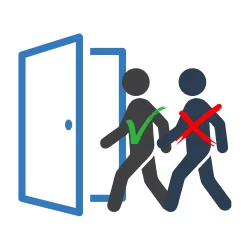
To explain what anti-tailgating is, it is first necessary to clarify what tailgating means in access control systems. Tailgating is the unauthorized passage through an access-controlled point by following an authorized person. It is one of the most common occurrences in access control systems and, at the same time, one of the most difficult threats to detect automatically.
Tailgating occurs virtually everywhere: in office buildings, industrial facilities, warehouses, logistics centers, and critical infrastructure. Any traditional access control system based solely on readers is vulnerable to this phenomenon. Of course, physical security measures such as gates, turnstiles, or mantraps effectively eliminate tailgating, but in practice they cannot be deployed at every office or server room entrance. Main entrances to office buildings or football stadiums are a different case. In such locations, these devices are specifically used to prevent unauthorized access to the premises.
The solution to this problem is NODER anti-tailgating: a system that achieves a high level of effectiveness by combining NODER access control with advanced video analytics. This approach provides real verification of the number of people passing through an access point, rather than merely confirming that access to a door has been granted.
Why is tailgating a real threat?
Tailgating occurs when one person properly authenticates in the access control system, while another person enters together with them without any authorization. This could be a courier, a co-worker, or someone attempting to access an area for which they do not have sufficient permissions. Most commonly, this happens:
out of courtesy from another employee,
due to inattention,
during periods of heavy foot traffic,
in facilities with a high turnover of employees or visitors.
How is such an event recorded in a traditional system? The system registers a correct entry by the authorized user, while in reality there are more people in the secured area than there should be, including individuals who may not have access rights. This is a direct violation of security rules that classic access control systems simply ignore because they are unable to detect it. Anti-passback can help in some cases, but implementing this functionality is not always possible or practical.
NODER Anti-tailgating: Access Control Integrated with Video Analytics
The NODER anti-tailgating solution eliminates this issue by combining access control with advanced video analytics.
The system is based on the integration of four components:
video analytics with real-time people detection and counting,
event management software,
system operators responsible for incident handling.
The system automatically analyzes:
the number of people detected in the passage area,
the number of valid access authorizations.
Any discrepancy is treated as tailgating and is immediately registered as an incident for verification by security system operators.
When tailgating is detected:
a real-time alarm can be generated,
the event is always recorded in system logs,
the operator gains access to the video recording linked to the incident,
an automatic response can be triggered, such as blocking subsequent passages.
Anti-tailgating Use Cases
Anti-tailgating is particularly effective in facilities where physical gates, turnstiles, or mantraps are impractical or impossible to deploy. This includes locations such as:
Importantly, the NODER anti-tailgating system is less expensive to deploy and operate than physical security solutions, as it can leverage existing CCTV cameras already installed at the site. These do not need to be cameras deployed specifically for anti-tailgating purposes.